
PDF document anonymization

Edito Omissis
Anonymization and pseudonymization of PDF files. Ensure the secure management of sensitive data within your PDF files.
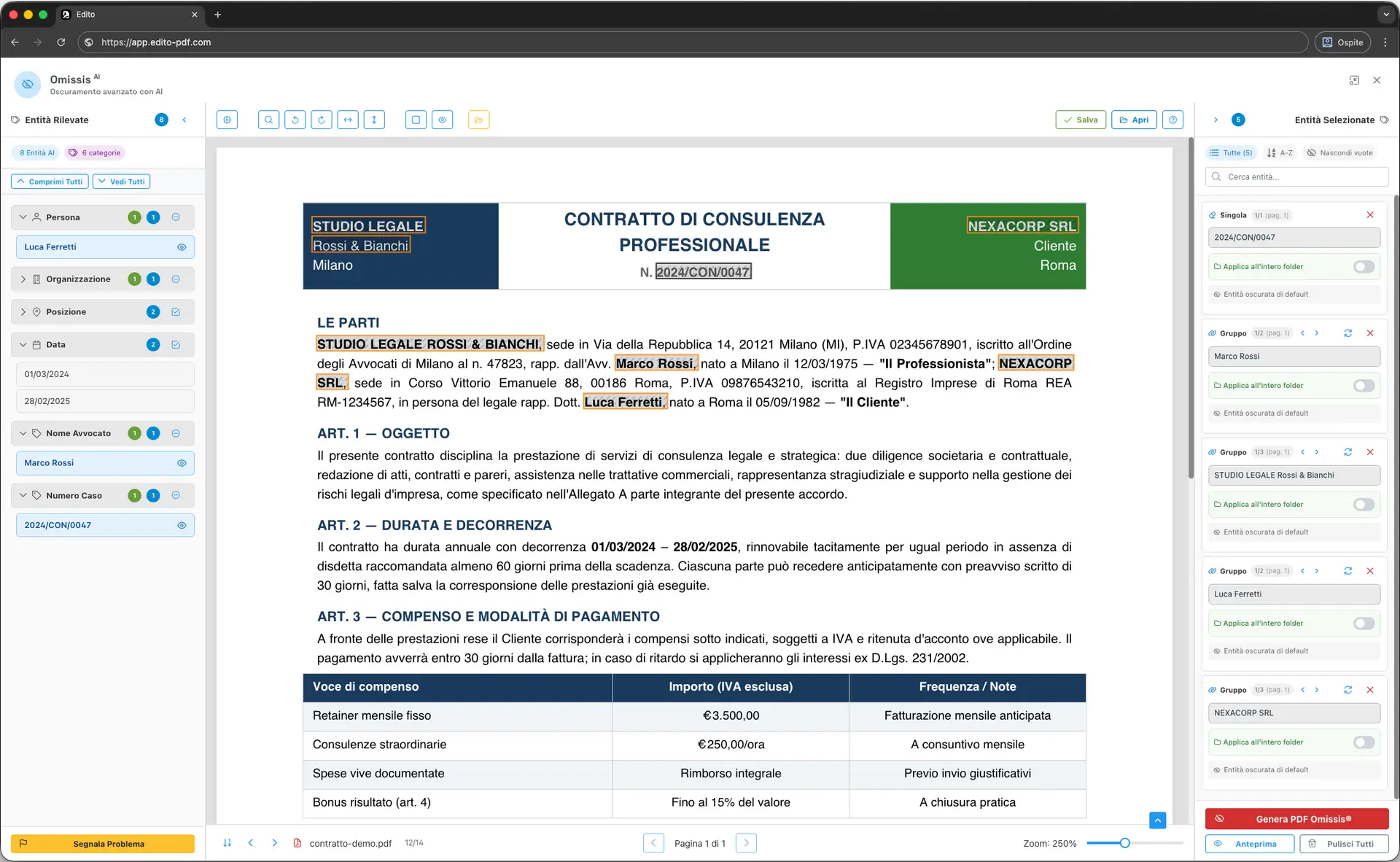
What you can do with Edito Omissis
From original documents to publishable, shareable, and compliant versions.
Mass and selective anonymization
Redact only what is necessary: personal data, sensitive references, and parameters defined by rules, even across large volumes of documents.
De-identification for research
Remove direct identifying data while keeping diagnoses, statistics, and content intact for scientific studies and AI applications.
Controlled pseudonymization
Replace sensitive data with secure IDs, maintaining the possibility of re-identification only for authorized individuals.
Who we recommend it for
Essential for those managing large volumes of personal data who must guarantee compliance and traceability.

Public Administrations
Publish resolutions, decrees, rankings, and CVs while respecting the transparency and minimization requirements of the GDPR. Regulatory Ref: Legislative Decree. 33/2013.


Healthcare and Research
De-identify medical reports and clinical records for medico-scientific use, longitudinal studies, and secure training of AI models.


Legal and HR Departments
Share deeds, files, or CVs using “clean” versions free of unnecessary personal data, always supported by an audit-proof operations log.


Banks and Credit Institutions
Prepare NPL documentation and securitization packages with complete anonymization. Reduce manual preparation time by 90% and ensure GDPR compliance for multi-million euro operations.

PA
Publish resolutions, decrees, rankings, and CVs while respecting the transparency and minimization requirements of the GDPR. Regulatory Ref: Legislative Decree. 33/2013.
Healthcare and Research
De-identify medical reports and clinical records for medico-scientific use, longitudinal studies, and secure training of AI models.
Legal and HR Departments
Share deeds, files, or CVs using “clean” versions free of unnecessary personal data, always supported by an audit-proof operations log.
Banks and Credit Institutions
Prepare NPL documentation and securitization packages with complete anonymization. Reduce manual preparation time by 90% and ensure GDPR compliance for multi-million euro operations.
Document anonymization software and PDF pseudonymization
Edito Omissis is Edito’s document anonymization software for teams that need to publish, share, or analyze PDFs without exposing personal data. PDF pseudonymization replaces names, national IDs, addresses, phone numbers, and other identifiers with tokens. The document stays readable and usable. Cleartext data does not leave Edito’s infrastructure: the link back to the original stays on Edito servers and is used only when an authorized operator needs to restore the text.
Manual redaction with black boxes is slow and fragile, because hidden text can still be copied. Omissis works on the PDF content. It detects entities and produces a version that can be shared. The engine uses a GLiNER2 model trained on 469,000 documents, with 62 entity classes and 6 European languages. Detection and replacement run on Edito servers. The file is not sent to an external AI provider to be anonymized.
469,000
Documents used to train the model.
62
Entity classes detected in the text.
6
European languages covered by the model.
Where PDF pseudonymization is used
Law firms and courts
Judgments, filings, and exhibits: personal details are removed and the legal reasoning stays intact.
Healthcare and research
De-identified reports and datasets, so diagnoses and measurements remain usable without identifying the patient.
Public administration
Decisions, rankings, and CVs published for transparency, without unnecessary personal data.
HR and companies
Contracts, files, and CVs shared with advisors, auditors, or internal systems.
What you get
01
Upload the PDF
One file or a batch. Omissis reads the content, not only the visible page.
02
Choose the categories
People, addresses, contacts, tax identifiers, and the other classes in the model.
03
Download the result
A permanent redaction, or a pseudonymized file whose key stays on Edito servers.
Redaction is permanent and fits documents that must circulate with no way back to the person. Pseudonymization keeps an internal identifier: a report can be read with the original data only at output time, on Edito’s server. That matches GDPR article 32: pseudonymized data remains personal data for as long as the key exists. Edito MCP connects an AI assistant to the pseudonymized file. The assistant works on the protected text. Cleartext, when needed, is restored only on the server at output time. Plans are on the pricing page.
FAQ
What is the difference between anonymization and pseudonymization?
Anonymization means the data can no longer be linked to a person, including by the organization that processed the file. Pseudonymization replaces it with an identifier that can be reversed only with a key held by Edito. GDPR articles 4 and 32 treat them differently: pseudonymization reduces risk, and the data stays personal while the key exists.
Can Omissis anonymize documents in bulk?
Yes. Process one PDF or a batch, with rules for the categories to redact: people, addresses, contacts, tax identifiers, and the other classes in the model.
Is the PDF sent to ChatGPT or another external model?
Not for anonymization. Entity detection and replacement run on Edito servers. An external assistant, if connected, receives text that is already pseudonymized.
Which languages does PDF pseudonymization support?
The model covers six European languages and 62 entity classes. It was trained on 469,000 documents.
How do I try it?
You try it on the platform: Sign Up opens the account and the 15-day trial, Log In is for an existing account. For a demo of anonymization, use Contact us. Plans are on pricing.